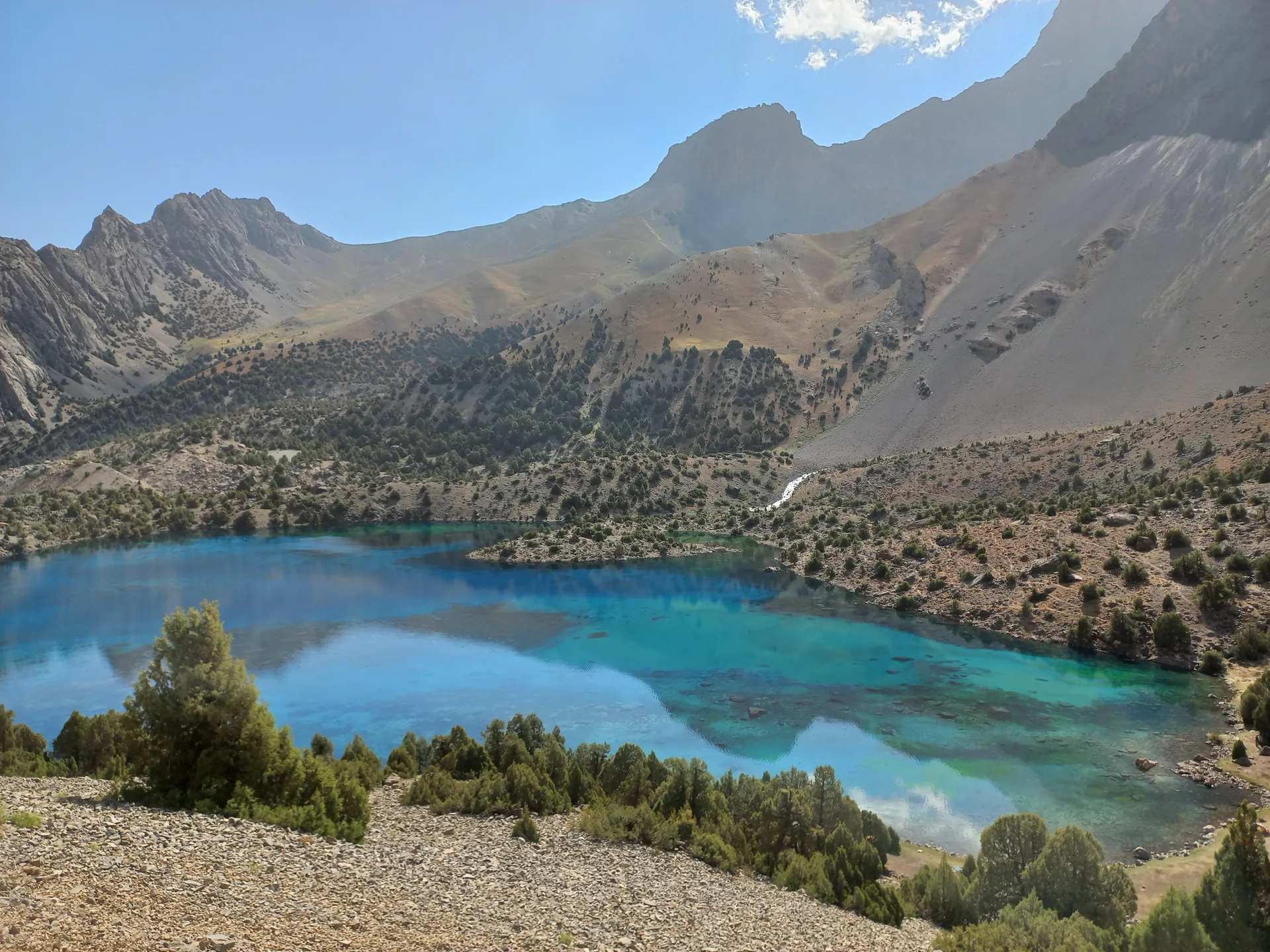
Part of the western Pamir-Alay system, this region - historically known as Kuhistan, or Mountainous Country - offers raw, pristine trekking with turquoise lakes, glacial passes, shepherd trails, and high camps below some of Central Asia's most dramatic peaks.
Use this guide to compare the main lake regions, understand the ecology and high passes, choose a realistic route, and prepare for the practical realities of hiking in remote Tajikistan.
Part 1
Geography, flora, and fauna
Geographically, the Fann Mountains act as a bridge connecting the Zeravshan Range to the north and the Hissar Range to the south. This enclosed position creates a localized microclimate that protects the region and supports biodiversity very different from the barren high-altitude deserts of the eastern Pamirs.
Unlike heavily commercialized mountain ranges, the Fanns remain refreshingly raw. Trails are shared with local shepherds, camps sit beside lakes of startling turquoise, and many high passes can still feel completely solitary.
The majestic peaks
The Fann Mountains contain more than a hundred peaks, many rising above 5,000 meters. The highest and most revered is Chimtarga Peak, a massive pyramid of rock and ice that dominates the central skyline.
- Chimtarga Peak - 5,489 m - the highest summit in the Fann Mountains.
- Chapdara - 5,050 m - a dramatic peak above the central lake basins.
- Bodkhona - 5,138 m - one of the region's major high summits.
- Mirali - 5,120 m - part of the skyline above Kulikalon.
- Zamok, The Castle - 5,070 m - a striking rock-and-ice formation.
Wildlife and ecosystem
The altitudinal zones create a layered ecosystem. Between roughly 2,000 and 2,800 meters, relict juniper forests give the lower valleys their sweet, sharp scent. The region is associated with more than 2,000 plant species, including endemic plants and curative herbs used by local communities.
Wildlife is easiest to notice when you travel quietly and start early. The highest crags and remote slopes support rare mammals and large birds, while marmots, mountain goats, and raptors are more commonly seen along trekking routes.
- Mammals - Snow leopard habitat lies in the highest crags, while brown bears, mountain goats, wild boars, marmots, and Marco Polo sheep are associated with the broader slopes and valleys.
- Birdlife - Golden eagles, Himalayan griffon vultures, mountain geese, and snowcocks patrol the skies above the passes.

Part 2
The three jewels of the Fann Mountains
A successful expedition into the Fanns usually revolves around its famous lakes. The region contains roughly 40 lakes, many formed by ancient landslides or glacial moraines. For planning purposes, the Fann Mountains are best understood through three distinct lake destinations.
Haft Kul: the Seven Lakes of the Shing Valley
Haft Kul means Seven Lakes in Tajik. This cascading chain sits in the narrow Shing Valley, where each lake occupies a different altitude between roughly 1,598 and 2,400 meters. Mineral content, depth, and sunlight create distinct colors, from deep indigo to milky jade.
- 1 Mijgon, Eyelash - Named for its curved shape and known for vivid turquoise water.
- 2 Soya, Shade - A lake that sits almost entirely in the shadow of sheer cliffs.
- 3 Gushor, Vigilance or Nimble - Known for a dramatic shoreline.
- 4 Nofin, Bellybutton - A long, narrow lake surrounded by small homestays.
- 5 Khurdak, Small - The smallest lake in the chain.
- 6 Marguzor, Blossoming Place - The largest lake, surrounded by meadows.
- 7 Hazorchashma, A Thousand Springs - The highest lake, fed by icy streams and rivers.
The experience
Haft Kul is ideal for cultural immersion. The trail largely follows a rugged dirt road linking traditional Tajik villages, so trekkers can hike lake to lake during the day and sleep in local homestays at night, sharing plov and fresh bread with families whose roots connect to the old Sogdian world.
Iskanderkul: the Lake of Alexander
Iskanderkul lies closer to Dushanbe, about 130 km from the capital, and rests at 2,195 meters. The massive triangular lake is tied to legends of Alexander the Great and his horse Bucephalus during the Central Asian campaigns.
The area is accessible and scenic. A short hike from the main lake reaches the roaring 38-meter waterfall often called Fann Niagara, while nearby Kuli Moron, or Snake Lake, adds another short-walk objective. The village of Saratog makes a useful base for guesthouses and for longer routes into the central Fanns.
The central lakes: Kulikalon, Alauddin, and Allo
The central lakes form the wild, high-altitude heart of the Fann Mountains and are generally reached on foot or by pack animal.
- Kulikalon Lakes - A multi-tiered plateau with more than a dozen interconnected lakes below the rock wall of peaks such as Maria and Mirali.
- Alauddin Lakes - Reached by high passes and known for crystalline water clear enough to reveal the lakebed.
- Allo Lakes - Bolshoye Allo and Maloye Allo were formed by major rockfalls and give remote trekkers a stronger expedition feel.


Part 3
Detailed Fann Mountains trekking itineraries
The strength of the Fann Mountains is route variety. You can choose a gentle cultural walk, a classic lake-and-pass loop, or a serious high-altitude expedition across Chimtarga Pass.
Route 1: the Haft Kul Cultural Traverse
- Difficulty
- Easy to moderate
- Duration
- 1 to 2 days
- Distance
- About 15 km one way
- Max altitude
- 2,400 m
Starting around Mogiyon or Shing, this route is straightforward and accessible. Altitude is gained gradually, so acclimatization is rarely a major issue. You can hike the length of the Seven Lakes without carrying a tent or heavy food supply by using guesthouses in villages such as Nofin and Marguzor.
This is the best introduction for travelers who want mountain scenery, local homes, village roads, and easier logistics before attempting higher Fann Mountains trekking routes.
Route 2: the Lakes Loop
- Difficulty
- Moderate to challenging
- Duration
- 3 to 4 days
- Start
- Artuch Base Camp, 2,200 m
- Max altitude
- Alauddin Pass, 3,860 m
This is the quintessential Fann Mountains trek, with one of the best reward-to-effort ratios in the region.
- Day 1 - Hike from Artuch through juniper forest to the Kulikalon plateau and camp among the lakes.
- Day 2 - Ascend the steep Alauddin Pass. From 3,860 meters, the view toward Chapdara and the surrounding peaks is one of the classic Fann Mountains panoramas. Descend to the Alauddin Lakes.
- Day 3 or 4 - Exit via Vertical Alauddin base camp, or extend the loop over Laudan Pass back toward the starting area.
Route 3: the Chimtarga Pass Expedition
- Difficulty
- Extreme
- Duration
- 8 to 12 days
- Max altitude
- Chimtarga Pass, 4,750 m
- Support
- Local guides and pack animals strongly recommended
This is the crown jewel of Fann Mountains trekking and one of Central Asia's great high routes. It requires excellent physical fitness, prior acclimatization, careful weather judgment, and reliable camp logistics.
- The route - The trek links the major central lakes, moving from Alauddin toward glacier-fed Mutnye, or Muddy, Lake at around 3,500 meters.
- The high camp - Trekkers push up steep scree to establish a camp around 4,400 to 4,500 meters on the eastern flank of Chimtarga.
- The pass - Crossing 4,750-meter Chimtarga Pass places you between Chimtarga and Energiya before a demanding 1,600-meter descent into the Zindan valley and onward to Bolshoye Allo Lake.
Part 4
Practical logistics and preparation
Venturing into the Fann Mountains requires careful planning. The region is welcoming, but it is still remote mountain country, and rescue services are limited. Route choice, weather, water safety, and reliable local logistics matter.
Best time to visit
- Prime trekking season - From late June through mid-September, high passes are usually clear of snow, and valley daytime temperatures often sit around 15 C to 25 C.
- Early June and late September - Useful for lower valley treks such as Haft Kul, but passes above 3,500 meters may be blocked by snow or affected by storms.
- Winter - Only for specialized ski touring and winter mountaineering because avalanche risk and cold are serious.
Guided tours vs independent trekking
Independent trekking is possible for highly experienced navigators carrying food, shelter, maps, and GPS devices. Trails are not marked to the standard many hikers expect in Europe or North America, so a guided tour is the better choice for most visitors.
- Pack animals - Local donkey drivers can carry tents, food, and heavy packs. Climbing a 4,000-meter pass with a light daypack changes the whole experience.
- Local value - Guides support remote mountain communities and add translation, route judgment, cultural context, and freshly cooked camp meals.
Permits and visas
- Visa - Tajikistan offers e-Visa access or visa-free entry for citizens of many countries. Check the current rule for your passport before booking flights.
- Trekking permits - The Fann Mountains are in Sughd Region and do not require the special GBAO permit used for the Pamir Highway. Keep your passport available for normal road checkpoints.
Essential gear list
- Shelter and sleep - Use a 3-season tent and a sleeping bag rated to at least -5 C for cold nights above 3,000 meters.
- Footwear - Bring sturdy, broken-in hiking boots with reliable tread for loose rock and scree.
- Water purification - Livestock share the mountains, so carry a filter or purification tablets for river and lake water.
- Clothing - Pack moisture-wicking base layers, a warm down jacket, and high-quality rain gear for sudden alpine storms.
Why the Fann Mountains deserve serious attention
The Fann Mountains represent the best of adventure travel in Tajikistan: ancient history, raw wilderness, accessible gateways, and enough trekking range to satisfy both first-time hikers and experienced alpine trekkers.
From the cultural warmth of the Shing Valley to the high, breathless terrain of Chimtarga Pass, the region offers a rare combination of beauty, solitude, and practical route variety.
Fann Mountains FAQ
These are the planning questions most people ask once the destination itself is on the shortlist.
When is the best time for Fann Mountains trekking?
Most multi-day trekking trips run from mid-June to mid-September. Late June through September works well for general hiking, while July and August are usually the most reliable months for higher pass crossings.
How high do trekkers usually go in the Fann Mountains?
Most classic trekking routes spend nights between roughly 2,200 and 3,500 meters, with major pass crossings often climbing well above 3,500 meters. The routes are usually non-technical, but altitude and sustained effort are real factors.
How do you get to the Fann Mountains in Tajikistan?
Most travelers approach from Dushanbe or from Samarkand in Uzbekistan via Panjakent. Depending on the route, common starting areas include Artuch, Iskanderkul, and the western valleys near the Seven Lakes corridor.
Why choose the Fann Mountains over a Pamir trek?
The Fann Mountains offer serious alpine scenery with shorter transfers, easier route combinations, and a wider mix of 3 to 7 day trekking options. For many travelers, they are the most efficient way to experience high mountain Tajikistan without building the whole trip around expedition logistics.
Planning guides
These related guides cover the practical questions that usually come next: route style, season timing, packing, and how to reach the trailheads.
Travel Guide
Fann Mountains Hiking Guide
An overview of route styles, trip planning priorities, and what travelers should know before booking guided hiking in the Fann Mountains.
Season Guide
Best Time for Fann Mountains Trekking
A season-by-season planning guide for travelers deciding when to schedule guided hiking and trekking in the Fann Mountains.
Packing Guide
Fann Mountains Packing List
A practical packing guide for guided hiking and trekking trips in the Fann Mountains, focused on layers, footwear, and trail essentials.
Logistics Guide
How to Get to the Fann Mountains
A planning guide for reaching the Fann Mountains, comparing transfer logistics, regional entry points, and what to confirm before your trek starts.
Private cross-border day trip
Seven Lakes day trip from Samarkand
Take a private Seven Lakes tour from Samarkand to Tajikistan with exclusive transport, a local guide, and coordinated border support.
Featured Fann Mountains tours
These live itineraries translate the destination overview into bookable route formats.
- 3-Day Marguzor 7 Lakes Tour - 3 days
- Fann Mountains Trekking Tour - 5 days
- 6-Day Northern Tajikistan & Iskanderkul Tour - 6 days